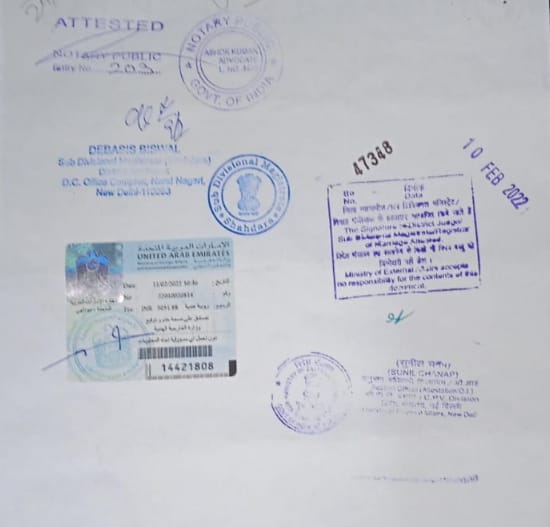
Attesting a police clearance certificate (PCC) means getting it legalized through the official attestation chain so a government, employer, or immigration authority outside the issuing country will accept it as genuine. For a UAE-issued PCC heading abroad, that means UAE Ministry of Foreign Affairs (MOFA) attestation followed by legalization at the destination country’s embassy or consulate in the UAE. For a foreign-issued PCC coming into the UAE, it means authentication in the issuing country, legalization by the UAE Embassy or Consulate there, and finally UAE MOFA attestation once the document arrives.
This guide walks through both directions step by step, since the PCC itself only confirms your conduct record — attestation is the separate process that makes it legally usable outside the country that issued it.
What Does It Mean to Attest a Police Clearance Certificate?
A police clearance certificate (also called a certificate of good conduct, criminal record check, or judicial record extract, depending on the country) and its attestation are two different things. Getting the PCC itself just confirms your record with the issuing police authority — see our guide on what a police clearance certificate is and, for the UAE specifically, our complete guide to getting a PCC in Dubai.
Attestation is the step after that: it confirms the signatures and seals on the certificate are genuine, so a receiving authority in another country — or, in the reverse direction, inside the UAE — can rely on it. Most visa applications, job offers, immigration processes, and some licensing applications that ask for a PCC also require it to be attested, not just issued.
How to Attest a UAE-Issued PCC for Use Abroad
If your PCC was issued by Dubai Police, Abu Dhabi Police, or a UAE federal authority and you need it accepted in another country, the process runs through two stages.
- Check how recent the certificate needs to be. Many receiving authorities only accept a PCC issued within the last few months, and attestation uses up part of that window. If your certificate is close to that limit, it’s often faster to request a new one than to attest an older certificate and risk it being rejected on arrival.
- UAE Ministry of Foreign Affairs (MOFA) attestation. Apply through the MOFA/MOFAIC portal or app with a UAE Pass account, selecting the issuing authority and document type. This confirms the certificate was genuinely issued by a recognized UAE authority.
- Destination country’s embassy or consulate legalization. After UAE MOFA attestation, the certificate generally needs to be legalized by the embassy or consulate of the country where you’ll use it — most of which have a presence in Abu Dhabi or Dubai. Requirements, fees, and processing time are set independently by each embassy, so it’s worth checking directly with the relevant one, or asking us to confirm it on your behalf, before you plan around a specific timeline.
Some destination countries only ask for the UAE MOFA stamp and skip their own embassy step; others require it. Since this varies by country and can change, confirm the exact requirement for your destination rather than assuming either way.
How to Attest a Foreign PCC for Use in the UAE
If your PCC was issued by a police authority outside the UAE and you need it accepted here — for a visa, employment, or another government process — the chain runs in the opposite order and starts in the issuing country.
- Authentication in the issuing country. The certificate first needs to be authenticated by the competent authority in the country that issued it — typically that country’s Ministry of Foreign Affairs or equivalent authentication department. This is usually where delays start, since processing speed depends entirely on that country’s own system.
- UAE Embassy or Consulate legalization. Once authenticated at home, the UAE Embassy or Consulate in that country legalizes the certificate. This step can only happen after the first one is complete — it can’t be done in parallel.
- UAE Ministry of Foreign Affairs (MOFA) attestation. The final stage happens once the certificate reaches the UAE: MOFA verifies the embassy legalization and issues the UAE’s own attestation, which is what UAE authorities actually check for.
If the certificate isn’t in English or Arabic, you’ll typically also need a certified translation before UAE MOFA will process it — our legal translation team can confirm whether yours needs one.
Does an Apostille Change Any of This?
Not on its own. The UAE is not a member of the Hague Apostille Convention, so an apostille from an issuing country never replaces the full UAE-bound chain. If your home country is a Convention member and issues an apostille instead of standard Ministry of Foreign Affairs authentication, that apostille only ever satisfies the first stage above — you still need UAE Embassy legalization and UAE MOFA attestation afterward. The reverse direction (a UAE-issued PCC going to an apostille-member country) works the same way: the UAE can’t issue an apostille at all, so the destination country’s own embassy or consulate legalization step is what stands in for it.
Fees and Processing Time
UAE MOFA’s attestation fee for an individual certificate is published at AED 150, with processing typically completed within 0–3 working days once the application is submitted correctly — courier delivery, where used, adds its own separate charge and timeline on top. Figures for the other leg of the chain — whether that’s a destination country’s embassy in the UAE or an issuing country’s authentication and UAE Embassy legalization abroad — aren’t published centrally, since each country and mission sets its own fees and turnaround. Contact us for a specific estimate once we know your document’s origin and destination.
Common Reasons PCC Attestation Gets Rejected or Delayed
- A certificate that’s aged out. Many receiving authorities only accept a PCC issued within the last few months — by the time attestation is done, an older certificate can fall outside that window.
- Lamination. A laminated PCC generally can’t be attested, since authorities need to apply physical stamps to the original document.
- Name mismatches between the certificate and your current passport, including after a legal name change.
- Wrong embassy jurisdiction — approaching an embassy or consulate that doesn’t cover the region where the document was issued or will be used.
- Skipping the authentication step in the issuing country before approaching the UAE Embassy there — embassies won’t legalize a certificate that hasn’t been authenticated first.
- Missing or uncertified translation, for certificates issued in a language other than English or Arabic.
Frequently Asked Questions
Is attesting a police clearance certificate the same as getting the certificate issued?
No. Getting the certificate is a separate step handled by the issuing police authority and confirms your conduct record. Attestation comes afterward and confirms the signatures and seals on that certificate are genuine, so an authority outside the issuing country can rely on it.
Do I need to attest a PCC if I'm only using it inside the country that issued it?
Generally no. Attestation exists to make a document acceptable outside the country that issued it. A UAE-issued PCC used for a UAE process typically doesn’t need UAE MOFA attestation — check with the specific authority requesting it to confirm.
Does an apostille replace UAE attestation for a foreign police clearance certificate?
No. The UAE isn’t a member of the Hague Apostille Convention, so an apostille only ever covers the home-country authentication stage. You still need UAE Embassy legalization and UAE MOFA attestation afterward, even if your home country issued an apostille instead of a standard authentication stamp.
How recent does a PCC need to be before it's accepted after attestation?
This varies by receiving authority, but many only accept a certificate issued within the last few months. Since attestation itself takes time, it’s worth checking the specific validity window with the receiving authority or embassy before you start, rather than assuming a standard period.
Can I attest a police clearance certificate after I've already arrived in the destination country?
It depends on the direction. For a UAE-issued PCC, UAE MOFA attestation has to happen in the UAE, but destination-country embassy legalization is often done through that embassy’s office in the UAE before you travel. For a foreign PCC coming into the UAE, the authentication and UAE Embassy legalization stages have to happen in the issuing country — only the final MOFA stage happens here.
What happens if my police clearance certificate is laminated?
It generally can’t be attested. Attestation authorities apply physical stamps and endorsements to the original document, which usually isn’t possible once a certificate has been laminated. If yours has been laminated, you’ll likely need to request a fresh, unlaminated copy from the issuing authority.
For the fuller picture of how UAE attestation works in general, see our guide on what certificate attestation means and why you need it. If you haven’t applied for your PCC yet, start with our complete guide to getting a police clearance certificate in Dubai, or see how a PCC compares to a certificate of good conduct. You can also see the full service on our Police Clearance Certificate service page.
Need Help Attesting Your Police Clearance Certificate?
We manage the full PCC attestation chain on your behalf — whether that’s UAE MOFA attestation and destination-embassy legalization for a certificate leaving the UAE, or authentication, UAE Embassy legalization, and MOFA attestation for a certificate coming in — so it’s accepted the first time.