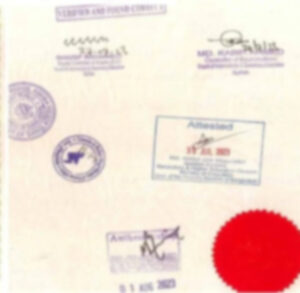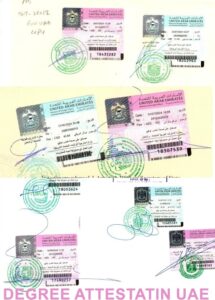
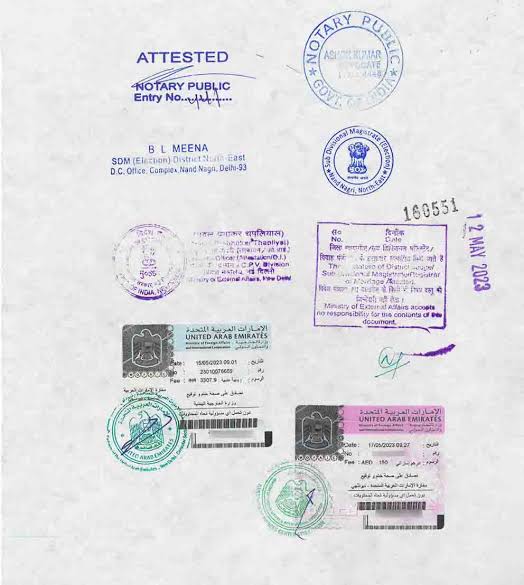
Certificate attestation is the process of verifying that a document — such as a degree, birth certificate, marriage certificate, or commercial document — is genuine, by having it stamped and endorsed by a defined chain of government authorities. Once attested, a document is legally recognized outside the country that issued it, which is why UAE authorities, employers, and universities require it before they’ll accept a foreign document.
If you’ve been told your degree, marriage certificate, or company documents need to be “attested” before they can be used in the UAE (or a UAE document needs attestation to be used abroad), this guide explains exactly what that means, how the process works, and why it exists.
What Is Certificate Attestation?
Attestation is a form of document legalization. It doesn’t change what a document says — it adds a chain of official endorsements confirming that the document is authentic, that it was issued by a legitimate authority, and that the signatures and seals on it are genuine. Each authority in the chain checks and endorses the authority before it, so by the time a document is fully attested, several independent government bodies have effectively vouched for it.
This matters because a government department, employer, bank, or university in one country generally has no way to verify a document issued by an authority in a different country. Attestation closes that gap: it’s the internationally recognized way of saying “this document, and the authority that issued it, can be trusted.”
Why Do You Need Certificate Attestation?
You’re likely to be asked for an attested document in situations such as:
- UAE residence, employment, or family visa applications — degree certificates, marriage certificates, and birth certificates are commonly required.
- Employment, particularly where a foreign qualification needs to be verified by a UAE employer or government body.
- University enrollment, where academic certificates from another country need to be recognized.
- Company formation and commercial transactions, where documents like board resolutions, certificates of incorporation, or commercial agreements need to be recognized by UAE authorities or foreign partners.
- Family and legal matters, including marriage registration, divorce proceedings, and inheritance, where civil documents need to be recognized across borders.
In nearly every case, the requesting authority isn’t questioning whether your document is real — they simply have no direct way to confirm it themselves, and attestation is the accepted way to provide that confirmation.
How Does the Certificate Attestation Process Work?
While the exact steps vary by document type and country of origin, most attestation chains for documents entering the UAE follow the same basic structure:
- Notarization (home country). A notary public or the issuing authority certifies that the document is genuine — for some document types, such as educational certificates, this may involve a solicitor or the issuing institution rather than a notary.
- Home country authentication. The relevant government department (typically a Ministry of Foreign Affairs or equivalent, sometimes an apostille authority) authenticates the notary’s or issuer’s signature and seal.
- UAE Embassy or Consulate attestation. The UAE’s diplomatic mission in the document’s country of origin legalizes the authenticated document.
- UAE Ministry of Foreign Affairs (MOFA) attestation. The final step, completed once the document reaches the UAE, confirms it is now recognized for official use by UAE government departments, employers, and institutions.
For UAE-issued documents that need to be used abroad, the process generally runs in the opposite direction — starting with UAE MOFA attestation and ending with legalization by the destination country’s embassy in the UAE.
Which Documents Typically Need Attestation?
Attestation requirements generally fall into three categories:
- Personal documents — birth certificates, marriage certificates, divorce certificates, death certificates, police clearance certificates, and powers of attorney.
- Educational documents — degree certificates, diplomas, and academic transcripts.
- Commercial documents — certificates of incorporation, board resolutions, articles of association, commercial invoices, and certificates of origin.
The exact chain — and which authorities are involved — depends on the document type, its country of origin, and where it will ultimately be used.
Attestation vs. Apostille vs. Notarization
These three terms are related but not interchangeable:
- Notarization is typically the first step in the chain — a notary or authorized official confirms a document (or a copy of it) is genuine.
- Apostille is a simplified, single-stamp form of legalization used between countries that are both members of the 1961 Hague Apostille Convention. The UAE is not a member, so documents used in the UAE generally require full attestation rather than a single apostille stamp.
- Attestation is the broader, multi-step legalization process — notarization, home country authentication, embassy legalization, and destination-country MOFA attestation — required for documents moving between non-Hague countries like the UAE and most of the rest of the world.
Is Attestation a One-Time Process?
Yes. Once a document has been fully attested for use in the UAE, that attestation doesn’t expire or need to be repeated for future use — you can reuse the same attested document for subsequent applications, as long as the document itself is still valid (some document types, like police clearance certificates, have their own validity windows independent of the attestation). This is one of the most misunderstood parts of the process: people sometimes pay to have the same document attested more than once when the original attestation would have been accepted.
How Long Does Attestation Take, and What Does It Cost?
Timelines and fees vary significantly depending on the document type, its country of origin, and which authorities are involved in the chain — a straightforward personal document can sometimes be completed in under two weeks, while documents requiring additional verification steps (such as degree certificates, which often need solicitor or institutional verification first) can take longer. Costs are set independently by each authority in the chain — the notary, the home country’s foreign affairs department, the UAE embassy, and UAE MOFA — so it’s best to get a specific estimate for your document type and country rather than relying on a general figure.
Frequently Asked Questions
What is certificate attestation?
Certificate attestation is the process of verifying a document’s authenticity through a chain of government authorities — typically notarization, home country authentication, embassy legalization, and destination-country Ministry of Foreign Affairs attestation — so it can be legally recognized and used outside the country that issued it.
What does it mean for a document to be “attested”?
An attested document is one that has completed the full chain of official verification and now carries the stamps or endorsements of each authority in that chain, confirming it’s genuine and can be relied on by government departments, employers, and institutions in the country where it will be used.
What is “attest” in the context of documents?
To attest a document means to formally verify and endorse it — confirming that it’s authentic and was issued by a legitimate authority — as part of the attestation chain required for the document to be accepted internationally.
Is attestation the same as notarization?
No. Notarization is usually just the first step in the attestation chain — a notary confirms a document or copy is genuine. Attestation is the full multi-step process, which includes notarization along with home country authentication, embassy legalization, and destination-country MOFA attestation.
Is attestation a one-time process?
Yes. Once a document is fully attested for use in the UAE, you don’t need to repeat the process for future use of that same document, as long as the underlying document is still valid.
Do all documents need to go through the same attestation process?
No. The exact chain of authorities depends on the document type (personal, educational, or commercial) and its country of origin — some documents require additional steps, such as solicitor verification for degree certificates.
For document-specific guidance, see our dedicated guides on degree certificate attestation, birth certificate attestation, marriage certificate attestation, and our full Attestation Services overview.
Need Help With Certificate Attestation?
Whatever the document and wherever it’s from, we manage the entire attestation chain on your behalf — from the first notarization to the final UAE MOFA stamp — so it’s accepted the first time.