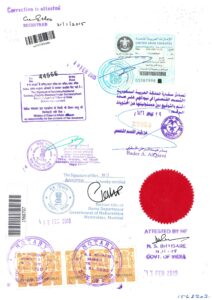
An apostille from the UK’s FCDO is the United Kingdom’s own authentication step — it confirms a UK document is genuine, but it is not, by itself, accepted for use in the UAE. Because the UAE is not a Hague Apostille Convention member, a UK document still needs UAE Embassy, London attestation and then UAE MOFA attestation inside the UAE after the FCDO apostille is issued. This guide covers what the FCDO apostille actually covers, what it costs, which documents can’t get an e-Apostille, and what still has to happen afterward — see also our guide to what certificate attestation means generally.
What Is an FCDO Apostille?
An apostille is a certificate the UK’s Foreign, Commonwealth & Development Office (FCDO) Legalisation Office attaches to a UK document. It confirms that the signature, seal or stamp on the document is genuine — not that the document’s contents are true. The UK has been a party to the Hague Apostille Convention since it came into force on 24 January 1965, so an FCDO apostille is recognised across every other Convention member country without further embassy involvement.
The UAE is not a party to the Apostille Convention. That single fact is why an FCDO apostille, on its own, is never enough for UAE use — it’s only the UK’s own home-country authentication step. A UK document bound for the UAE still needs UAE Embassy, London attestation and then UAE MOFA attestation inside the UAE after the apostille is issued.
How Much Does an FCDO Apostille Cost?
Per GOV.UK’s official fee schedule (get-document-legalised, page updated 14 Oct 2026):
- Paper apostille (standard): £45
- Next-day paper apostille: £40 — yes, cheaper than standard, exactly as published on GOV.UK’s page
- Restricted/Urgent service: £100, limited to registered businesses only, not individuals
- e-Apostille: £35
Standard processing is usually up to 25 working days, so plan well ahead of any visa or employment deadline if your document is headed for UAE use.
Which Documents Can't Get an e-Apostille?
GOV.UK’s own rules exclude several document categories from the e-Apostille service entirely — these must use the paper apostille instead:
- Birth certificates
- Death certificates
- Marriage certificates
- Adoption certificates
- DBS certificates and other disclosure or fingerprint (police) certificates, including ACRO and Scottish/Northern Irish equivalents
This is an FCDO/GOV.UK rule, not something the UAE invented — but it lines up with the UAE side too. For personal-status documents like birth, marriage and death certificates, the UAE requires physical original documents regardless of the apostille format. For police-clearance documents (ACRO, DBS and other disclosure or fingerprint certificates), no e-Apostille route exists either, so a paper apostille is the only workable option on both sides.
Which Documents Can the FCDO Apostille?
Per GOV.UK’s own “documents we can legalise” guidance, the FCDO only apostilles:
- UK public documents
- Documents signed by a UK-recognised official, solicitor or notary
- Official-registry documents, such as GRO (General Register Office) certificates and Companies House certificates
Non-UK documents cannot be apostilled by the FCDO — if a document was issued outside the UK, this process does not apply to it.
Can the UAE Accept an FCDO Apostille on Its Own?
No. The UAE is not a Hague Apostille Convention party, so an FCDO apostille is only ever the UK’s own authentication step, never a stand-alone solution for UAE use. After the FCDO apostille is issued, the document still needs:
- UAE Embassy, London attestation — by post, the Embassy states up to 5 working days (undated page); through the digital route, 2–3 working days (also undated, mofa.gov.ae)
- UAE MOFA attestation inside the UAE
One point is still an open question we can’t resolve from the Embassy’s own published pages: whether the London digital-attestation copy already bundles a separate UAE MOFA stage into the same application, or whether UAE MOFA attestation is always a separate step afterward. We state this plainly as unresolved rather than guess — see our breakdown of UAE Pass digital attestation for UK documents for more on how the digital route itself works.
For a full cost breakdown of the whole UK-to-UAE chain, see how much UK degree attestation for the UAE actually costs.
Do Commercial Documents Follow the Same Route?
Generally, yes. Commercial documents — certificates of incorporation, good standing, articles of association — follow the same apostille, then UAE Embassy London, then UAE MOFA chain as personal documents. If a certified copy of a UK company’s own records is needed first, Companies House’s ordering page (updated 17 Aug 2026) prices these at £22 standard / £65 express, or £44 / £130 for incorporation documents specifically. Once the certified document is in hand, the FCDO apostille and UAE Embassy, London steps above apply the same way. See our apostille services in Dubai page for how we handle the UAE side of this chain for any document type.
Frequently Asked Questions
Is an FCDO apostille the same as UAE attestation?
No. An FCDO apostille is only the UK’s own authentication step, confirming a UK document is genuine. Because the UAE is not a Hague Apostille Convention member, it does not accept an apostille on its own — the document still needs UAE Embassy, London attestation and UAE MOFA attestation afterward.
How much does an FCDO apostille cost?
GOV.UK’s get-document-legalised page (updated 14 Oct 2026) lists £45 for a standard paper apostille, £40 for next-day paper (cheaper than standard, as published), £100 for the Restricted/Urgent service (registered businesses only), and £35 for an e-Apostille. Standard processing is usually up to 25 working days.
Can I get an e-Apostille for a birth or marriage certificate?
No. GOV.UK’s own rules exclude birth, death, marriage and adoption certificates from the e-Apostille service, along with DBS and other disclosure or fingerprint certificates. These require the paper apostille instead — and the UAE separately requires physical originals for personal-status documents, so a paper apostille is the practical choice either way.
What happens after the FCDO apostilles my document?
The apostilled document goes to the UAE Embassy, London for attestation (up to 5 working days by post, or 2–3 working days through the digital route, per the Embassy’s undated pages), and then to UAE MOFA attestation inside the UAE. Whether the Embassy’s digital copy already includes the MOFA stage isn’t confirmed on any official page, so we treat it as an open question rather than assume either way.
Can the FCDO apostille a non-UK document?
No. Per GOV.UK’s own guidance, the FCDO only apostilles UK public documents, documents signed by a UK-recognised official, solicitor or notary, or UK official-registry documents such as GRO or Companies House certificates. A document issued outside the UK can’t be apostilled by the FCDO.
Do commercial documents need the FCDO apostille too?
Generally, yes. Certificates of incorporation or good standing follow the same apostille, then UAE Embassy London, then UAE MOFA chain as personal documents. If a certified copy of a UK company record is needed first, Companies House’s ordering page (updated 17 Aug 2026) prices these at £22 standard / £65 express (£44 / £130 for incorporation documents).
Sources and last reviewed: GOV.UK, get-document-legalised (page updated 14 Oct 2026); GOV.UK, documents-we-can-legalise; UAE Embassy, London attestation and digital-attestation pages (mofa.gov.ae, undated); GOV.UK, Companies House certified-copy ordering page (updated 17 Aug 2026); HCCH Apostille Convention status table. Reviewed 2026-11-08.
Need Your UK Document Attested for the UAE?
We handle the FCDO apostille, UAE Embassy, London attestation, and UAE MOFA attestation end-to-end, so you don’t have to chase three separate offices yourself.