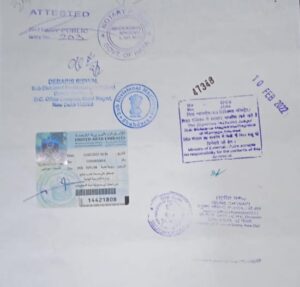
To get a medical certificate attested for use in the UAE, the process depends on where the certificate was issued. A medical certificate or sick leave report issued inside the UAE is attested electronically through the Ministry of Health and Prevention (MOHAP); a medical certificate issued outside the UAE has to go through the standard international attestation chain first — home-country authentication, UAE Embassy or Consulate legalization, and UAE Ministry of Foreign Affairs (MOFA) attestation — before it can be certified for use here.
If your employer’s HR team, your insurer, or a UAE government department has told you a medical certificate needs to be “attested” before they’ll accept it, this guide walks through both paths step by step, what documents to have ready, and where applicants most often get stuck.
When Does a Medical Certificate Need Attestation in the UAE?
Attestation confirms that a medical certificate is genuine before a UAE authority relies on it for a decision. You’ll typically be asked for an attested medical certificate for:
- Sick leave claims with your employer, especially leave beyond a few days or leave that needs to be backed up for HR or payroll records.
- Health insurance claims, where the insurer needs to verify a diagnosis, treatment, or period of incapacity.
- Extended or repeated sick leave, which UAE labour law and company policy generally require to be certified by a recognised medical authority.
- A medical certificate issued in your home country that you need a UAE employer, school, or government department to accept as valid.
This is a different process from the medical fitness test that new residents complete inside the UAE as part of a residence visa application (the blood test and chest X-ray at a GDRFA- or DHA-approved centre) — that test is carried out and recognised entirely within the UAE and isn’t something that gets “attested” afterward. Medical certificate attestation, by contrast, is about validating a specific medical document — a sick leave note, a medical report, or a health certificate — that already exists.
If Your Medical Certificate Was Issued in the UAE
Sick leave certificates and medical reports issued by UAE medical facilities are attested through the Ministry of Health and Prevention’s (MOHAP) online system, not through MOFA. The steps are:
- Get the certificate from a licensed medical facility. It has to come from a government hospital, a MOHAP-licensed primary healthcare centre, or a licensed private facility.
- Check whether it needs emirate-level approval first. Sick leave issued in Dubai or Abu Dhabi generally needs to be approved by that emirate’s own health authority before MOHAP will process it.
- Apply through the MOHAP website or smart app using UAE PASS, within one month of the certificate’s issue date — applications submitted later aren’t accepted.
- Enter the facility licence and medical report details and attach the required documents (see the checklist below), then submit.
- Wait for medical committee review, if your leave requires it. Leave of five days or less is usually attested electronically without any committee review. Leave of more than five days, up to one month, needs sign-off from the emirate’s medical sub-committee. Leave spanning more than a month needs approval from MOHAP’s Higher Medical Committee.
- Pay the attestation fee and download the attested certificate once it’s approved.
One shortcut worth knowing: if the private facility that issued your sick leave already uses MOHAP’s own sick-leave system, the certificate is generally already certified at the point of issue and doesn’t need this extra attestation step — check with the clinic or your HR team before you start.
If Your Medical Certificate Was Issued Abroad
A medical certificate issued outside the UAE can’t go straight to MOHAP. It first has to pass through the same attestation chain used for other foreign personal documents:
- Notarization or local health-authority verification (home country). The issuing doctor, hospital, or clinic’s record is first verified or notarized in the country where it was issued — the exact body varies by country, but it’s often the hospital administration or a local notary.
- Home country Ministry of Foreign Affairs authentication (or apostille). Your home country’s Ministry of Foreign Affairs, or equivalent federal department, authenticates the signature and seal from the step above.
- UAE Embassy or Consulate legalization (home country). The UAE’s embassy or consulate in your home country legalizes the document, confirming it recognizes the authentication completed above.
- UAE Ministry of Foreign Affairs (MOFA) attestation. Once the certificate reaches the UAE, MOFA verifies the embassy legalization and applies its own attestation stamp.
- MOHAP certification, if the certificate is being used as sick leave or a medical report. For sick leave and medical reports specifically, MOFA attestation isn’t the final step — the certificate is then referred to a medical committee for review before MOHAP will certify it for use with a UAE employer or insurer.
If you’re attesting a different kind of medical document — a general health or fitness certificate for a visa file rather than sick leave or an insurance claim — the MOFA stage above is usually where UAE-side attestation ends; confirm with the specific authority requesting the document (your employer’s PRO, the school, or the immigration department) whether any further step applies in your case. If the certificate isn’t in English or Arabic, it will also need a certified translation before any of these authorities will accept it — our legal translation services team can confirm which of your documents need this.
Documents You’ll Need
Exact requirements vary by where the certificate was issued and what it’s being used for, but most applicants need:
- The original medical certificate or sick leave report, in unlaminated condition.
- A copy of your Emirates ID (for UAE-issued certificates) or passport copy (for certificates issued abroad).
- The medical facility’s licence details or supporting medical report, for leave beyond five days.
- A certified translation, if the certificate isn’t issued in English or Arabic.
- An authorization letter, if you’re using a representative or attestation agent to handle the process on your behalf.
- Proof of relationship, if the certificate supports an escort or dependent’s leave rather than your own.
Common Reasons It Gets Rejected or Delayed
- Applying too late. MOHAP generally only accepts attestation requests within one month of the certificate’s issue date.
- Skipping the emirate-level approval step for sick leave issued in Dubai or Abu Dhabi, before submitting to MOHAP.
- Lamination — a laminated certificate generally can’t be attested, since stamps need to go directly onto the original.
- Starting the international chain from inside the UAE. The home-country and UAE Embassy stages have to happen in the country where the certificate was issued — they can’t be completed after you’ve already arrived in the UAE.
- Missing or incorrect translation, for certificates issued in a language other than English or Arabic.
- Assuming every medical document follows the same route. Sick leave and medical reports go through MOHAP’s medical committee process; other medical documents may stop at the MOFA stage — check with the authority requesting your certificate.
How Long Does It Take, and What Does It Cost?
For a UAE-issued sick leave certificate, MOHAP’s own published fee is AED 50, and electronic applications that don’t need medical committee review are typically processed within two working days; add roughly a week when a sub-committee or the Higher Medical Committee needs to review longer leave. For a certificate issued abroad, timelines depend on the home country’s notarization and Ministry of Foreign Affairs stages, which vary widely by country, plus the UAE Embassy and UAE MOFA stages once the document reaches the UAE-side part of the chain. Because each stage and authority sets its own pace and fees, it’s best to get a specific estimate for your certificate, its country of origin, and its intended use rather than relying on a general figure.
Frequently Asked Questions
How do I get a medical certificate attested for use in the UAE?
It depends on where it was issued. A certificate from a UAE medical facility is attested electronically through MOHAP; a certificate issued abroad has to go through notarization, home-country MOFA authentication, UAE Embassy legalization, and UAE MOFA attestation first, and is then referred to MOHAP if it’s being used as sick leave or a medical report.
Does a medical fitness test for a UAE residence visa need to be attested?
No. The medical fitness test completed at a GDRFA- or DHA-approved centre as part of a UAE residence visa application is carried out and recognised entirely within the UAE, so it doesn’t go through attestation. Attestation applies to separate medical certificates and reports, not this in-country test.
Can I attest a UAE sick leave certificate myself, or do I need an agent?
You can apply directly through the MOHAP website or smart app using UAE PASS if the certificate qualifies for electronic attestation (generally leave of five days or less). Longer leave that needs medical committee review, or a certificate issued abroad, is more involved, and many people use an attestation service to manage the documentation and follow-up.
Do private hospital sick leave certificates in the UAE need separate MOHAP attestation?
Not always. If the private facility already issues sick leave through MOHAP’s own sick-leave system, the certificate is generally already certified and doesn’t need a further attestation step. Check with the clinic or your HR team to confirm.
How long does medical certificate attestation take in the UAE?
For a UAE-issued sick leave certificate without committee review, MOHAP’s electronic process typically takes about two working days. Certificates needing medical committee review, or certificates issued abroad that must complete the full international chain first, take longer and vary by case — it’s best to get a specific estimate for your situation.
What happens if my medical certificate isn’t in English or Arabic?
It will need a certified translation before UAE authorities — including MOHAP, MOFA, and your employer or insurer — will accept it. Confirm which documents need translation before you start the attestation process.
For the fuller picture of how UAE attestation works end to end, see our guide on what certificate attestation means and why you need it. If you’re attesting other personal documents alongside your medical certificate, our Personal Documents Attestation page covers the full range, and our Nursing Certificate Attestation guide is useful if you’re also attesting professional healthcare credentials. You can see the full service breakdown on our Medical Certificate Attestation service page.
Need Help Attesting a Medical Certificate?
We manage the entire process on your behalf — from home-country authentication for certificates issued abroad, to UAE Embassy legalization and MOFA attestation, to MOHAP certification — so your medical certificate is accepted the first time by your employer, insurer, or the relevant UAE authority.