True copy attestation is the process of having a government authority officially verify that a certified true copy of a document is genuine and recognized for use in another country. Where a certified true copy simply confirms a photocopy matches its original, true copy attestation goes a step further and authenticates that copy through the Ministry of Foreign Affairs (MOFA) and, where required, embassy legalization — the step that actually makes it acceptable to a foreign government.
If you’ve been told your document needs “true copy attestation” and you’re not sure how that’s different from getting a certified true copy — or whether you need one, the other, or both — this guide walks through the definition, the difference, and exactly how the process works.
What Is True Copy Attestation?
True copy attestation is the government-level authentication of a certified true copy, confirming that the copy — and by extension the original document it represents — is legitimate and can be relied upon by an authority outside the country where it was issued or certified. It typically involves:
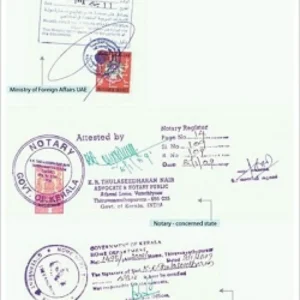
- Verification by the relevant home-country authority (such as the notary attestation department or Ministry of Foreign Affairs) that the certifying notary’s signature and seal are genuine.
- Legalization by the destination country’s embassy or consulate, where required.
- For documents entering the UAE, a final stamp of attestation from UAE MOFA.
Once attested, the true copy carries an official chain of verification that a foreign government, employer, or institution can trust — something a certified true copy on its own does not provide.
True Copy Attestation vs. Certified True Copy: What's the Difference?
This is the question behind most of the confusion, so it’s worth stating plainly:
- A certified true copy confirms that a photocopy is an exact, unaltered match of the original document. It’s issued by a notary public, solicitor, or the document’s issuing institution, and it only tells the reader “this copy matches the original.”
- True copy attestation confirms that the certified true copy itself — and the certifying authority behind it — is genuine and recognized internationally. It’s issued by government bodies (home-country MOFA, destination embassy, and UAE MOFA where applicable), and it tells the reader “this document and its certification are legitimate and accepted across borders.”
In short: a certified true copy is usually the first step, and true copy attestation is the verification of that step for international use. Most authorities that ask for an “attested true copy” want both — a properly certified copy that has then gone through the attestation chain — not either one alone. For the fuller picture of how attestation works end to end, see our guide: What Is Certificate Attestation? Meaning, Process & Why You Need It. And if you’re not yet sure what a certified true copy itself involves, start with What Is a Certified True Copy? Meaning & Attestation Process.
When Do You Need True Copy Attestation?
True copy attestation is typically required when a certified copy of a document — rather than the original — needs to be submitted to an authority in another country, and that authority needs assurance the copy is legitimate. Common situations include:
- Visa and residency applications, where a certified copy of a degree, birth certificate, or marriage certificate must be attested before it’s accepted by UAE immigration or a foreign consulate.
- Employment abroad, where a foreign employer or licensing body wants an attested true copy of your qualifications rather than risking loss of the original.
- Company and commercial filings, where an attested true copy of a trade license, incorporation certificate, or board resolution is submitted instead of the original.
- Banking and legal proceedings, where courts or financial institutions require an attested copy standing in for a document that must otherwise stay with its original holder.
- Keeping the original document safe, when you need the same certificate for more than one application or country at the same time.
If an application specifically says “attested copy” or “true copy attestation required,” a plain certified true copy on its own will not be accepted — it needs to go through the attestation chain first.
How Does the True Copy Attestation Process Work?
The steps typically run as follows:
- Start with a certified true copy. Have the original document copied and certified by a notary public or the issuing institution, confirming the copy is an exact match.
- Home-country verification. The certified copy goes to the relevant authority in the country where it was certified (for UAE-issued documents, this is typically the Ministry of Justice or notary attestation department) to confirm the certifying notary’s signature is genuine.
- Ministry of Foreign Affairs attestation. The home country’s MOFA authenticates the document at a national level.
- Embassy legalization (if required). The embassy or consulate of the destination country legalizes the document for use in that country.
- UAE MOFA attestation (for documents entering the UAE). As the final step, UAE MOFA attests the document so it’s fully recognized by UAE authorities.
The exact sequence and which steps apply depend on the document type and the countries involved, which is why it’s worth confirming the required chain before starting rather than partway through.
Which Documents Commonly Need True Copy Attestation?
True copy attestation most often comes up for:
- Educational documents — degree and diploma certificates, especially when the original must stay with the issuing university.
- Personal/civil documents — birth, marriage, and divorce certificates.
- Commercial documents — trade licenses, certificates of incorporation, board resolutions, and commercial invoices.
- Legal documents — powers of attorney, affidavits, and wills.
Whatever the document type, the underlying logic is the same: the copy has to be certified first, then attested, before a foreign authority will treat it as reliable.
Frequently Asked Questions
What is true copy attestation?
True copy attestation is the government-level authentication of a certified true copy, confirming that both the copy and the notary or institution that certified it are genuine and recognized for use in another country.
Is true copy attestation the same as a certified true copy?
No. A certified true copy only confirms a photocopy matches its original. True copy attestation is a separate, later step where government authorities (home-country MOFA, destination embassy, and UAE MOFA where relevant) verify and legalize that certified copy for international use.
Do I need both a certified true copy and attestation?
In most cases, yes. You typically need a certified true copy first, then have that copy go through the attestation chain — one step without the other usually won’t satisfy a foreign authority’s requirements.
How long does true copy attestation take?
Timelines vary by document type and destination country, since they depend on home-country MOFA processing, embassy legalization (if required), and UAE MOFA attestation. Get in touch with our team for a timeline specific to your document and country.
Can I get true copy attestation done without the original document?
The certification step (getting the true copy certified) requires the original for comparison. Once that’s done, the attestation steps that follow work from the certified copy itself, so you don’t need to keep submitting the original at every stage.
Which authority does true copy attestation in the UAE?
For documents entering the UAE, the final step is attestation by the UAE Ministry of Foreign Affairs (MOFA), following home-country notarization/MOFA attestation and embassy legalization where required.
For document-specific guidance, see our Attestation Services overview, or get in touch and we’ll confirm exactly which certification and attestation steps your document needs.
Need Help With True Copy Attestation?
Whether you need a certified true copy, full attestation, or both handled end to end, we manage the entire process on your behalf so your documents are accepted the first time, wherever they’re going.